A Horizontal Concept of Harmony for the Jazz Soloist
Many saxophone players (and horn players in general) have a complicated relationship with harmony. This can be for a whole spectrum of reasons ranging from a) the feeling that you struggle to stay on top of it, and essentially leave it up to whoever’s playing the chords to take care of it while you try to be melodic, to b) caring deeply about it, but being very frustrated that, when there’s someone playing chords, you have very little control over it.
Sax legend David Liebman's new course is designed to be the ONLY course on saxophone sound you'll ever need. This streaming video series features the most effective sound production techniques and concepts he's come across over decades spent helping saxophonists to find their biggest, richest, and most compelling voice on the horn.
David takes the same methods that were taught to fellow legends (Michael Brecker, Eddie Daniels, and other giants), and expands on them so that players at any level (including those who don't have a ton of time to practice each week) can start building the kind of sound that truly turns heads.


My book Sideways: a Horizontal Concept of Harmony for the Jazz Soloist was written to try to arm the single-line instrumentalist with a range of voice-leading tools to help tackle this issue. I’m happy to say that the feedback I’ve received suggests that it can provide you with a strong alternative harmonic approach to the one you may have followed throughout your development as an improvising musician up until now. There are real practical exercises in there—the familiarity one can build through physical repetition of them is beneficial.
But really they are just examples of ways to manifest something bigger, which is—not just a method, but a methodology. The book presents a way of thinking about harmony that will take you beyond the standard approach of “OK, here’s the chord—now what can I play on it?”, toward something more like “Where does this harmony come from, and how can I bring it to life and take it on a journey?”
The raison d’être for the whole project for me is perhaps best encapsulated (like so many things in this world) by the late master Wayne Shorter:
“Composition is just improvisation slowed down, and improvisation is just composition sped up.”
Similarly, the great pianist Paul Bley describes improvisers as “composers who work in real time”. I’m sure we’d all like to think of ourselves this way. But, if that’s really true, shouldn’t the methods used in improvisation and composition more fully resemble one another?
Vertical vs. Horizontal Harmony
While pondering this question in the early stages of my PhD project, upon which the book is based, I stumbled across a startling comment made on social media by renowned pianist/composer/arranger Jim McNeely. It was made in reference to a blog post by pianists Ethan Iverson and Michael Kanan, in which they compared the original chord changes on a number of standards to the way they’re commonly played today:
“With most of these composers it was about the voice-leading in the underlying harmony. The practice of reducing almost everything to some kind of II–V, in fact the whole tradition of reducing everything to named vertical structures—what is the word I’m looking for—sucks.”
What are these “named vertical structures” Jim is talking about? They are chord symbols themselves. But wait: surely the chord symbols are the harmony! Take those away and what’s left?
That question reflects the deeply ingrained attitude toward harmony held by many improvising jazz musicians—including myself—as a vertical, static concept. When the bar begins, there’s a C-major chord, which sits there for a little while until along comes the bar line and now we’re on E-minor, as though the C never happened.
It takes skill—possessed by the best chordal instrumentalists but not on the same level by horn players—to look at chord symbols and instantly extrapolate fluid harmonic movement (something that chord symbols usually tell you nothing about). And the chord/scale method—wherein melodic lines are created by superimposing scales, arpeggios and other patterns on top of chord symbols—if overly relied upon, allows and can even encourage you to avoid this harmonic sensitivity altogether.
I always used to have this sense, as a jazz musician, that there was something special about us, because of the way we can hear and identify the harmony of a piece of music. Whenever I listened to music, I was mentally converting everything I heard into chord symbols, feeling very confident in my attitude that that was where the real harmony lay. But if we look back at a piece of classical music and conjure up that shorthand (which is essentially what chord symbols are) in our minds, does that mean that was the way the music was written?
That Bach, when writing the Cello Suite No. 1 in G major, was thinking, “OK, I’ve got my chord progression: G major, C over G, then D over G and back to G. Now what shall I have the cellist shred over it?!” Clearly not. Although we can’t get into Bach’s mind, we can tell he was hearing a melody—indeed, multiple melodic tiers. The combination of these melodies is what makes the harmony, not the other way around. But the other way around is precisely how we in jazz often approach the relationship between melody and harmony.
Voice-Leading
Part of this is for an obvious reason: if we’re improvising a solo on a standard, the harmony actually does come first. We can’t just launch into a solo where we improvise three separate lines that go wherever they want to go and still call it “All the Things You Are.” But there is a middle ground between that and the mere superimposition of scales, arpeggios and other patterns on top of chord symbols on a lead sheet. And that ground is called voice-leading.
“OK,” you might be thinking, “are you really telling me that all the great solos I’ve heard over ‘All The Things You Are’ consist of mere superimposition of scales and patterns?” Not the great ones, because great jazz artists have a way of playing—their own personal approach—that transcends this. I’m talking about the mediocre, dime-a-dozen, perfectly competent but instantly forgettable solos (the kind I’ll freely admit to having played). A large proportion of our learning energy is focused on the question “What can I play over this chord?” and the answer is often a scale, a superimposition, a pattern or a lick.
Now, anyone who’s heard me play knows that I’m not opposed to scales and harmonic superimpositions. I’m not above playing patterns, and there’s no denying there are plenty of licks that surface in my playing. They’re creative. I just want to broaden the ways the things I play are generated. This began for me as a new perspective on harmony, but it also changed how I think of and play melody. I’ve found the ability to play lines that are unified and coherent over longer passages of music, rather than popping up and immediately disappearing, and I’ve begun decluttering my improvised lines.
In my PhD thesis I examine how single-line instrumentalists have approached harmony through jazz history, then study chordal instrumentalists and, through transcription and analysis, tease out devices they use to command harmony as a horizontal phenomenon—contrapuntal autonomous lines. The greatest chordal instrumentalists make the harmony sound like something they are inventing themselves, not something that already exists on a lead sheet to “play over.” Single-line instrumentalists aren’t usually in the business of commanding harmony—it commands us.
Implied Polyphony
I am all too aware of the seemingly insurmountable obstacles here. Chief among them being the fact that we can’t play lines simultaneously. That is indeed the mother of all obstacles when it comes to playing harmony. But, as a Bach cello suite shows us, it doesn’t mean we can’t conjure up harmony by implying polyphony.
It should be clear from my references to Baroque music that the concepts I’m interested in here are not new. And it’s very important to point out that you will hear great single-line instrumentalists in jazz (particularly on the tenor saxophone, which has a really good range for this) already doing the kind of thing I’m encouraging you to work on here. I can think of examples throughout the history of jazz, from Coleman Hawkins’s iconic solo on Body and Soul, all the way through to such contemporary advanced harmonic players as Mark Turner, Chris Potter and Ben Wendel, among others. Listen to the work of these guys through this lens, and you’ll hear a lot of harmonic imagination that goes way beyond expert use of the chord/scale method.
What awaits you in the book is a host of devices I’ve developed, inspired by the work of the chordal instrumentalists I’ve studied, each one accompanied by an example of how it can be practiced. There are also transcriptions of some of my recordings where I’m using these devices to help you get the sounds in your ears and under your fingers if you have trouble improvising them. It is my hope that the ideas in the book start you on a journey toward reclaiming some autonomy over harmony in single-line jazz improvisation, by turning it sideways, embracing voice-leading, and discovering that harmony and melody—much like improvisation and composition—are essentially the same thing. I’m going to include an example of the exercises from the book here, to give you a sense of what’s inside.
We’re going to practice some open triadic voice-leading here, and then add a little harmonic twist. Below is an example of open triadic voice-leading over the chord progression to “All the Things You Are,” by Jerome Kern. This is such a great tune for practicing different harmonic approaches on, for any number of reasons (it’s very commonly played, and it gets around, harmonically!). The principle here is to play all the notes from every triadic iteration of the chords, while ensuring that every part of every triad (bottom, middle and top) move as little as possible. This will obviously result in the inversion changing frequently, depending on how close one chord is to the next. The “open” part refers to the fact that we’re spreading out the voices across the range of our instrument:

Obviously the above example is but one way the exercise can be fulfilled. You can start on any one of three different notes (since we’re dealing with triads for now), and can move in different directions with each chord change.
The next step toward the goal of treating every tier of harmony as its own independent melody is to add approach tones to each one, much as you might with a single line. The example below shows you what happens if you add an approach from a half-step below the bottom tier from the example above. In order to hear the harmonic effect of this, I play each triad twice—once with the approach note, and once more with the triad played in resolution.

The same should also be done with the middle and top tiers, and with different types of approaches—scale note above, above and below, etc. Again (at the risk of sounding like a broken record!), the written examples are merely examples. Each exercise in the book (and there are 30) should be improvised anew every time. Hopefully working through the exercise above will give you a sense of just how infinite the range of possibilities is likely to be.
After a good amount of time working on the exercises I compiled (and they’re compiled in such a way as to give you plenty of ideas as to how to expand and adapt them further), I found that I was getting closer to my goal of achieving some agency over harmony by horizontal means, but there were side effects too.
Here are some of my observations about the effect it’s had on my own playing. The first four are obvious, in that they are the whole point of the enterprise:
1. Technical agility
2. A more fluid command of harmony
3. Ability to keep two or more lines active in my brain in real time
4. The big one: an evolving ability to create harmonic variation out of horizontal movement, rather than through vertically imposed chord/scale systems
The last two are happy side effects, with some elaboration:
5. Ability to maintain unity within longer solos and solo forms. It is a commonly expressed desire among improvising jazz artists to “develop” one’s ideas in real time during the course of a solo. This is necessary in order to generate and maintain coherence within the spontaneous form of what often ends up being a two-to-four-minute musical unit, but the goal remains elusive to many of us. It is my suspicion that the chord/scale method (or at least our use of it) bears some responsibility here. When using scales, arpeggios and patterns to create a kind of simulation of a complete melody, I often find that there is little left to develop. In incorporating our method, I have found that even the attempt to maintain coherent autonomous lines within a broader solo has resulted in a slowing-down of the amount of information generated in the form of notes and rhythms. This leads to more space for reflection on that which occurs while it occurs, as opposed to the more common sensation of delivering a line and then, in the process of continuing to the next one, forgetting it in a barrage of information.
6.One aspect of single-line improvisation that has always concerned me is the notion of spontaneous balancing of pitches within a melodic line. If an improviser has no other guide upon which to base their decisions regarding pitch selection than the compendium of scales, arpeggios and patterns that the chord/scale method provides, there is the likelihood that the pitch contour of an improvised passage will feel somewhat random, or unidirectional, unless some deliberate intervention is made. A scale typically moves in one direction, and it is not uncommon to find an improviser follow one until they reach the outer edges of their comfortable range, at which point they may change direction, or simply return to the top or bottom of the range and start again. In such a case, the architecture of a melodic line, so frequently found in music that is composed, is ignored. A balancing structural trait often found in a clear melody in any genre involves the melodic range of a phrase being defined early, often by a large interval (or consecutive smaller ones), with the remaining melodic material in the phrase operating within that frame.
In the book I offer examples from classical music, and also my own recorded music, to support and explore the ideas above. They are all inspired by, and contribute to the idea I attempted to articulate at the beginning: that melody and harmony are essentially the same thing, and that, if we treat them as such, we can reinvigorate our approach to both, and, along the way, shake up our whole way of improvising.
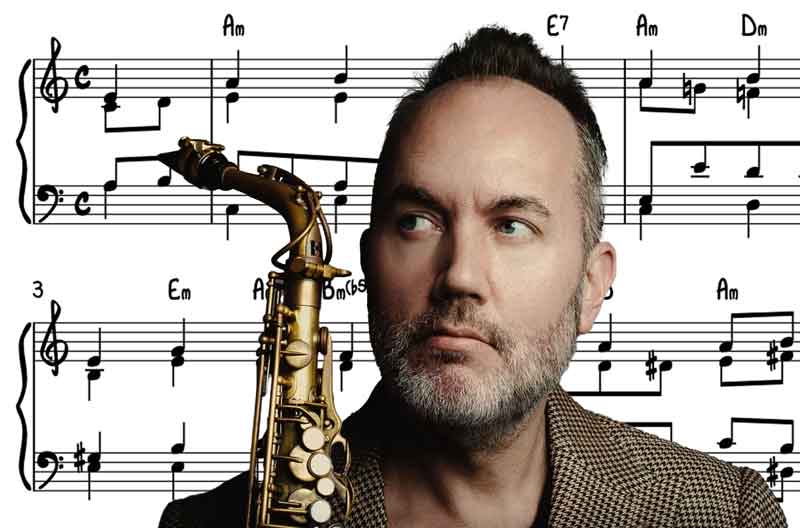
For many sax players, harmony can feel like it’s always being steered by the piano or guitar. In Sideways: A Horizontal Concept of Harmony for the Jazz Soloist, Will Vinson shows how horn players can take real agency by rethinking harmony from vertical to horizontal. The book lays out 30 progressive exercises that challenge and inspire players at any level.