



Major Scale Exercises for Learning Polyrhythms
 This begins as a simple exercise in practicing 2-octave major scales in all 12 keys, ascending and descending, at increasing speeds.
General Idea
- Start from low Bb, and play each scale in 2 octaves up and down, repeating the bottom note before moving up a half step to the next scale.
- Instead of speeding up by changing the metronome speed, build speed by using polyrhythms.
Exercises for Putting it into Practice
- Start at half note = 84.
- Start with 8ths (groups of 4). Then go to quintuplets, then to sextuplets, then septuplets. etc.
In order to make the exercise more rhythmic, use articulation groupings.
Sax legend David Liebman's new course is designed to be the ONLY course on saxophone sound you'll ever need. This streaming video series features the most effective sound production techniques and concepts he's come across over decades spent helping saxophonists to find their biggest, richest, and most compelling voice on the horn.
David takes the same methods that were taught to fellow legends (Michael Brecker, Eddie Daniels, and other giants), and expands on them so that players at any level (including those who don't have a ton of time to practice each week) can start building the kind of sound that truly turns heads.


Da-at dut dut in the case of 8ths
Da-at da-at-dut for quintuplets
Da-a-dut da-a-dut for sextuplets
Da-at da-at da-at-dut for septuplets, etc.
CLICK HERE TO DOWNLOAD A PDF WORKBOOK WITH ALL OF THE FOLLOWING EXERCISES.
Please note, the music notation examples below are just excerpts, please use the workbook linked to above to see the actual exercises in their completeness.
Example 1 shows the scales in groups of 4-9.

The groups of four are already interesting, since the scale pattern has 29 notes, (7+7 up and 7+8 down)— so, as you cycle up the keys, the articulations turn around (rotate) with respect to the scales.
The articulations re-coincide with the scale at the major 3rd up for the groups of 4 (ie D major, m. 15 middle, the 29th half note; and F# Major on bar 30, the 29th whole note). For quintuplets they re-coincide at the perfect 4th up; for sextuplets at the tritone up; etc.
The scales themselves change in a 4:29 polyrhythm with respect to the pulse for groups of 4, 5:29 for quintuplets, 6:29 for sextuplets, etc.
Also, inasmuch as the rhythm of the scale cuts across the pattern of articulations, it’s like you’re playing two meters at once within the polyrhythm, one outlined by the articulations, the other by the scale structure.
These are very difficult exercises to master, especially as you get up in the stratospheres of 9s 10s and 11s. But if you do them regularly it puts all the articulations on different parts of the scale in your body and your ear.
Example 2 shows the 10’s and 11’s.

I also imagined further extensions — for example, using fluctuating subdivisions. That is, instead of just doing the exercise using 5’s, or 9’s, why not, for example, oscillate between 5’s and 9’s:
Example 3
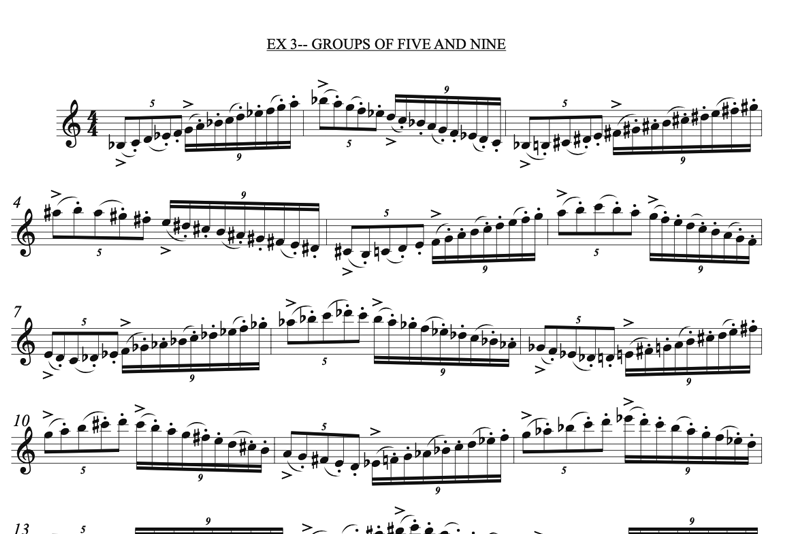
This one is particularly rad, since the 5+9 pattern generates multiples of 14, including 28, whereas the scale pattern is 29 notes, so each new scale starts 2 bars and 1 note in the pattern later than the previous.
Till now we’ve been dealing with the situation where the articulation matches the polyrhythm, but we could have the articulation cut across the polyrhythm as well. Just to take one example, you could have the oscillation between 5’s and 9’s where the articulation remains in patterns of 5’s throughout.
Example 4

This creates a really disorienting, psychadelic effect!
One could go through all possible combinations of two polyrhythms, or one could add a 3rd, a 4th, or even create a series using a complete set of polyrhythms ranging from, say 4-11. Practicing this studiously can really hone your ability to move quickly and precisely between related tempos.
Example 5
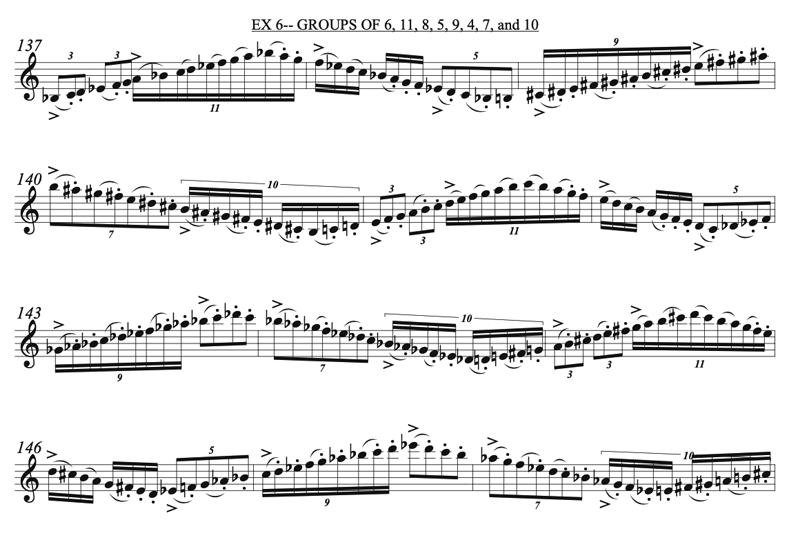
Varying articulation patterns independently, the number of possible combinations really starts to explode.
The major scale needn’t be the pattern on which this exercise is based, you can use any scale or even any intervallic pattern. I was recently working on using this idea while practicing 13th chords going up diatonically by step.
At some point the piling of complexity on complexity will create an unrecognizable stew, so you have to create your exercises carefully!
I’d be happy to hear about it if anyone delves into this and finds something interesting. Feel free to contact me through my website.
“Zimmerli explores an exhilarating style that combines the spontaneity and exuberance of jazz with the complexity and rigor of the modernist composers he admires.” – The New Yorker
Patrick Zimmerli is celebrating the launch of his onward record label, EMP (Emergence Music Productions). Its inaugural release Songs of Innocence features Zimmerli with Kevin Hays (piano) and Satoshi Takeishi (percussion). Learn more at EmergenceMusic.org.



October 28, 2025 @ 11:39 pm
I am currently looking at the exercises you posted regarding the 4 note cell- ascending in minor thirds. I would appreciate any musical material the group can send. I am always looking for new ideas.
Thank you,
Ron Burris, Saxophonist