Using Triad Pairs for Hip and Modern Lines
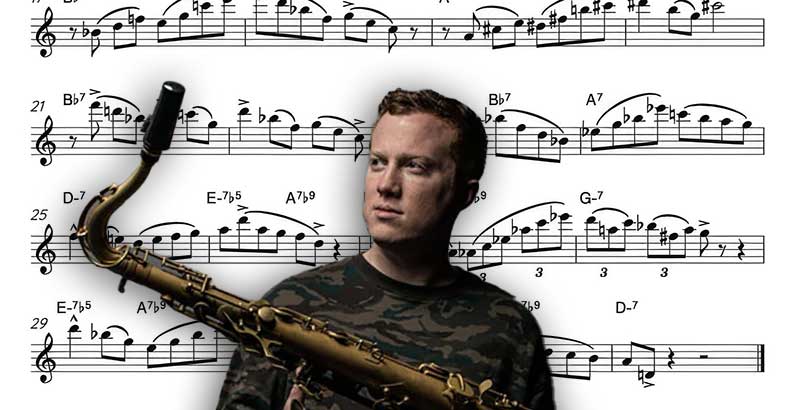
My new book, Try It! 13 Triad Pair Jazz Etudes is a collection of etudes composed primarily using triad pairs that are linked by whole step and tri-tone.
Sax legend David Liebman's new course is designed to be the ONLY course on saxophone sound you'll ever need. This streaming video series features the most effective sound production techniques and concepts he's come across over decades spent helping saxophonists to find their biggest, richest, and most compelling voice on the horn.
David takes the same methods that were taught to fellow legends (Michael Brecker, Eddie Daniels, and other giants), and expands on them so that players at any level (including those who don't have a ton of time to practice each week) can start building the kind of sound that truly turns heads.


As a young student, I remember finding Gary Campbell’s Triad Pairs for Jazz method book life-changing, as it helped distill otherwise difficult sounds (V7alt as an example) into two triad pairs, linked in creative ways. So much so, that I wrote a short e-book on the topic called Crash Course: Triad Pairs, that helped me flesh out some of the most useful parts of the book into my own playing.
Over the years, I’ve found that triad pairs have been a very useful and worthwhile device to study, practice and integrate into my own improvisation and pedagogy.
It’s my hope that the Etudes, along with their written analysis, will give you an insight into the power of triad pairs as applied to many different chords/sounds and that you’ll find use for them in your own playing. The book also comes with recordings of me playing each etude as well as a background track without me playing, for you to take the lead.
Below is a sample etude written over the chord changes to the song “You and the Night and The Music”, in Bb transposition. In addition to the etude, I’ve included the written analysis for the triad pairs being used in the measures where they occur. All references to triads are in concert key.
One of the most important skills I’ve ever worked on is the ability to transpose from concert, whether it’s reading music on the fly or ciphering through scores/analyses, this skill has proved very important for me throughout the years.
Let’s take a look at the etude and corresponding analysis.
CLICK HERE FOR A PRINTER-FRIENDLY PDF FOR DOWNLOAD
Style: Swing
Written over: “You and the Night and the Music”
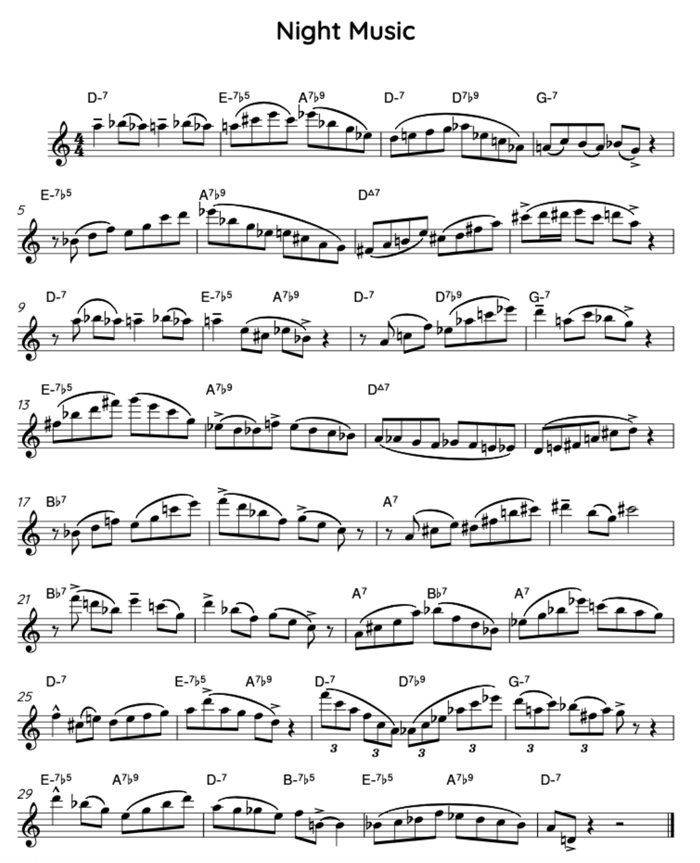
Triad Pairs Used:
Measure 2: Major Triad pairs in tri-tones as applied from the root and the tri-tone of the V7 chord. (Concert G and Db).
Measure 6: Major Triad pairs in tri-tones as applied from the root and the tri-tone of the V7 chord. (Concert G and Db).
Measure 10: Major Triad pairs in tri-tones as applied from the root and the tri-tone of the V7 chord. (Concert G and Db).
Measure 11: First two beats, major triad from the third. Second two beats, major triad from the tri-tone.
Measure 13: Augmented triad from the #2 and major triad from natural 13.
Measures 17 and 18: Major Triad pairs in whole steps as applied from the root and the second of the chord. (Concert Ab and Bb). Yields V7#11 sound.
Measures 19 and 20: Major Triad pairs in whole steps as applied from the root and the second of the chord. (Concert G and A). Yields V7#11 sound.
Measures 21 and 22: Major Triad pairs in whole steps as applied from the root and the second of the chord. (Concert Ab and Bb). Yields V7#11 sound.
Summary
As you can see, the majority of the application of the triad pairs are from three sources, which I’ll flesh out below:
Source 1: Major triads from the 1st and 2nd scale degree on a Major Chord and/or Dominant 7th chord. The result of the former is the Major 7 #11 sound and the result of the latter is the V7#11 sound.
Source 2: Major triads from the 3rd and 4th scale degree on a Minor Chord, which highlights the 3rd, 5th and 7th as well as the 11th, 13th and Root of the chord.
Source 3: Major triads from the Root and Tri-tone of the V7 chord, giving the sound of V7#11b9 and strongly implying the tritone substitution sound.
There are of course many, many other ways to apply triad pairs to all types of harmony but even a cursory look at the analysis of the etude contained in this article shows that the three sources listed above are heavily used, among other applications.
Happy shedding!
If you enjoyed this article and the etude, you can dive deeper with the book that it was based on, Try It! 13 Triad Pair Jazz Etudes